
For an Anthropology of Geopolitics

There has been an outpouring of grief among Shi‘i Muslims across the world at the death of Ayatollah Khamenei. An anthropology of geopolitics that foregrounds relational geographies and granular analyses of ordinary peoples’ interpretations of world events can help better understand this mourning.
The month of Ramadan is a time for fasting and feasting, for spiritual reflection and community solidarity. This is reflected in images of prayer, of greater charity, and of iftar gatherings. In many parts of the Shi‘i world this year, images of Ramadan could be mistaken for those associated with Muharram, when Shi‘as commemorate the martyrdom of their spiritual founding figure, Imam Husain, at the Battle of Karbala in 680 CE.The battle took place in present-day Iraq between the army of Yazid (descendant of the Ummayads) and the followers of Husain, the grandson of Prophet Muhammad, who Shi‘as believe was denied rightful succession to the Caliphate. Historical echoes of this moment reverberated through the recent killing of the Supreme Leader of the Islamic Republic of Iran, Ayatollah Ali Khamenei, and led to an outpouring of grief among Shi‘i Muslims across the world, including in South Asia, where I conduct research. Despite the violent repression of civilian dissent in Iran by Khamenei, he has been elevated to the status of a martyr by grieving Shi'i minorities in South Asia who recall Karbala and its meaning: a struggle against injustice and oppression.*
The sensorium of mourning
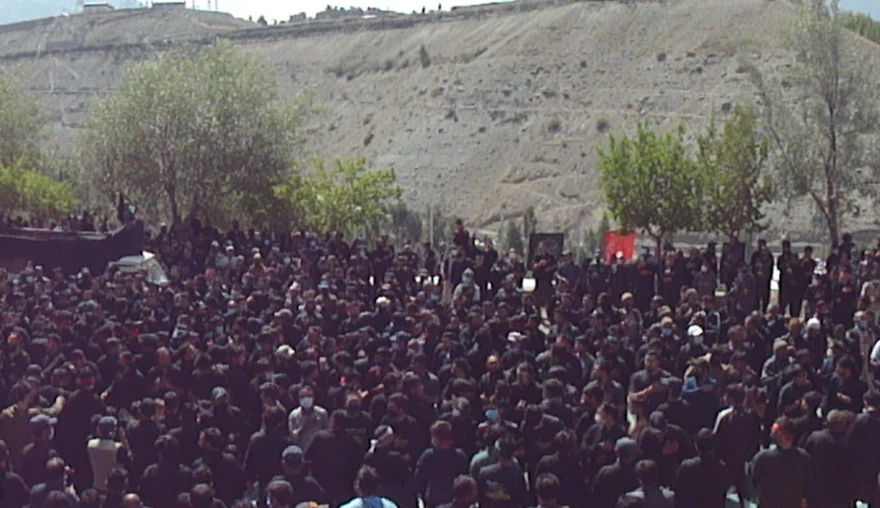
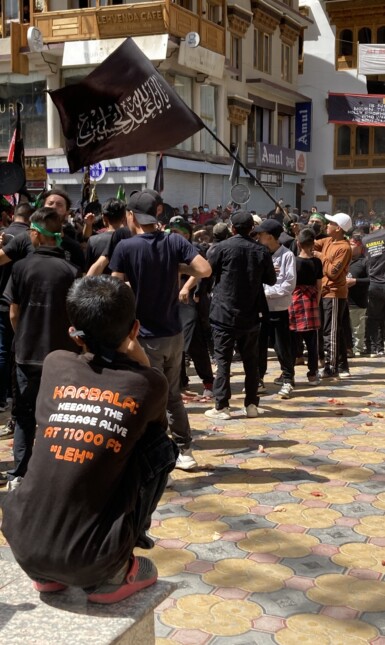
I first witnessed the collective effervescence of Muharram processions during my doctoral fieldwork in Kargil, a Twelver Shi‘i majority region of Ladakh in the Indian Himalayas. It was an intensely sensory experience, animated by lamentation expressed through the rhythmic coordinated thumping of chests in mourning assemblies and processions, the crescendo of weeping at key points in the narration of the events of the Battle of Karbala, the transmission of nauhas (rhythmic dirges) through loudspeakers, and singing of marsiyas (elegiac poetry). This week, social and news media are filled with images from Kargil, showing thousands of people – young and old, men and women – taking to the streets in processions reminiscent of Muharram. Drone photography shows a sea of people clutching photos of Khamenei, carrying miniature replicas of coffins, raising fists and chanting slogans against imperial oppression in ‘julus-e-shahadat-e-Khamenei’ (procession to mourn the martyrdom of Khamenei), virtually relaying the affective charge of Muharram processions. A seven-day period of mourning was announced in this ‘remote’ Himalayan location. Shi‘i community leaders in India have taken the analogy of Catholics’ emotional devotion to the Pope to explain their grief at the passing of Khamenei.
Alignment with Ali Khamenei was never unequivocal in the Twelver Shi‘i world. It was underlined by differences of opinion on the institution of the Velayat-e-Faqih (Guardianship of the Jurist), established by Ayatollah Khomeini after the 1979 Iranian Revolution, wherein the supreme jurist becomes the legitimate inheritor of the religious and political authority of the Prophet and the Imams. These differences were reflected in intra-sectarian factionalism even in a small place like Kargil. Yet mourning for Khamenei has transcended these divides. It has even united Sunnis and Shi‘as in some places in India. As scholars of Shi‘ism have commented, for minorities in South Asia, Khamenei was a symbol of dignity and strength. This is captured by a frequent quote found on Muharram banners: “Death with dignity is better than a life of humiliation,” a sentiment that has re-circulated during Ramadan 2026. For many, Iran has been revered as ‘Maktab-e-Husaini’ (School of Husain), and the 1979 Revolution lent Shi’as greater confidence in their religious identity.
Anthropological enquiry in ‘small places’ can tell us much about ‘large issues’
An ethnography of ‘peripheral’ Shi‘i locales might appear inconsequential for realpolitik international affairs. But, at this moment in history, I have realised with ever more clarity how my research on intra-sectarian politics in Kargil helped me to understand the global geopolitical stakes of Shi‘i politico-religious identifications. The study of geopolitics, traditionally the terrain of scholars of International Relations, can benefit from an engagement with the anthropology of geopolitics. This subfield offers a granular understanding of ordinary peoples’ engagement with and interpretations of world events beyond culturalist and functionalist approaches. The foundation for the crystallisation of this new subfield was arguably laid shortly after the end of the Cold War in the 1990s with the publication of seminal pieces such as ‘The Song of the Non-Aligned World:Transnational Identities and the Re-inscription of Space in Late Capitalism’, which commented on a newly ushered in era marked by capitalist globalization.
More recently, drawing upon Black feminist scholars, anthropologists have asked “What would it mean for anthropology to more explicitly engage with geopolitics – to foreground a phenomenon often relegated to the ‘context’ of our work – by grappling with its grounded instantiations across the world”? To respond to this question is to underscore “geographies of relationality” by revealing how a small place like Kargil – conventionally trapped by methodological nationalism – is, in fact, located within wider geopolitical and global imaginaries. The epistemological value of an anthropology of geopolitics also rests in its fundamentally interdisciplinary character, cutting across anthropology, history, and politics. It demonstrates in explicitly legible ways the value of our discipline to an understanding of global social and political transitions so urgently needed in a period of geopolitical turmoil perhaps not seen since the end of the Second World War.
*This article was updated after publication on 17 March 2026.



3 Comments
Great article for UPSC aspirants preparing with Anthropology Optional. The preparation strategy and answer writing tips shared here are really useful for improving Mains performance.
Website - https://www.vijethaiasacademy.com/
Call us Now - 7291915677 | 9650852636
As an Iranian, reading this text is deeply disturbing. To write about the 'mourning' for Khamenei without acknowledging the brutal domestic oppression he orchestrated is a severe omission. What you romanticise as a beautiful, organic expression of the Muharram ritual is, in reality, the result of 47 years of calculated manipulation by the Islamic Republic. The regime has systematically weaponised this religious tradition, pouring Iranian oil revenues into a global propaganda machine designed to export its totalitarian ideology and manufacture these exact displays of grief abroad. To analyse this as an 'anthropology of geopolitics' while entirely erasing the state violence and financial engineering behind it is not just an analytical failure, it is a profound moral one.
Thank you for taking the time to read and comment on this blogpost. Your thoughts on the violence towards civilians in Iran by the regime are well taken. The analysis in this post is limited in scope to the perspective coming from Kargil where I reflect on how fieldwork there helped me to understand geopolitics. I do discuss the export of the 1979 revolution in my book, hyperlinked in this post.
Add a comment