
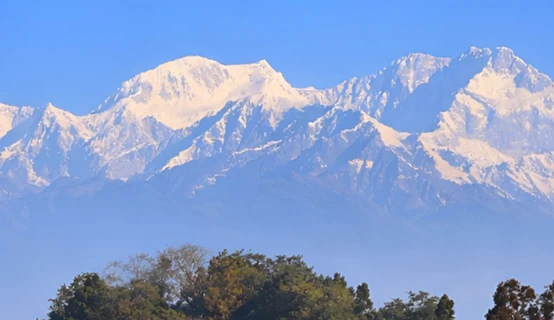
Sensing Darjeeling: Spatial rethinking of the Himalayan town


In January, the NWO-funded project Futuring Heritage: Conservation, Community and Contestation in the Eastern Himalayas held an academic workshop in Darjeeling, followed by an ethnographic workshop, Sensing Darjeeling. This blog reflects on this event and its sprouting outcomes.
Beyond Institutionalised Heritage
The Futuring Heritage project values collaboration in research and analysis beyond academia. Now in its second year, the project's annual workshop took place in January in Darjeeling, Abhimanyu’s hometown. Our academic conference was followed by a two-day ethnographic workshop ‘Sensing Darjeeling’.
Darjeeling, a Himalayan town in India between Nepal and Bhutan, embodies a distinctive temporality. The term heritage surfaces both in everyday parlance and in the ways the colonial past is continually, yet in ever-changingly, folded into the present. It is often framed through its colonial-era buildings, the toy train designated as a UNESCO World Heritage Site, and the tea gardens established by British colonisers in 1841. In many ways, the triad of tea, timber, and the toy train speaks for Darjeeling.
Drawing inspiration from sensorial cartography, Erik de Maaker (PI), Abhimanyu and Anna tried to move beyond these inherited buzzwords. Instead of mapping Darjeeling’s heritage as spectacle or history as monument, we approached the Himalayan town as lived and felt, revealing what remains invisible within spectacular narratives of colonial legacy and authorised heritage.
Participants involved regional experts, academics, and local residents, including college students, a veterinarian, and filmmakers. We grouped them, and each was assigned a location: a tea plantation, Bazaar, a satellite forest, Darjeeling railway station, and a Tibetan refugee camp.
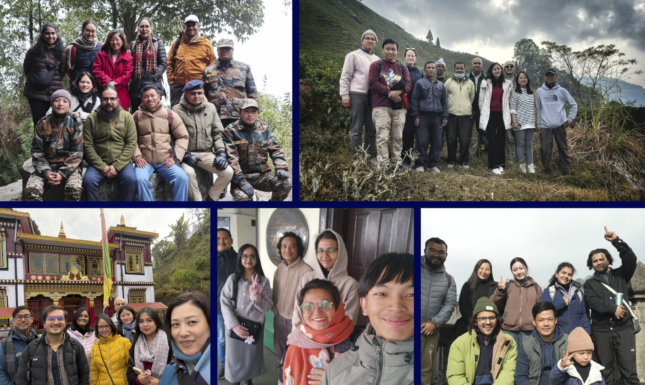
What does Darjeeling mean beyond its image as a tourist destination? Who, and what, inhabits its spaces? How do they shape the temporalities of its postcolonial heritage value? And what might its futures look like? We sensorially explored these questions.
Moving with Bazaar
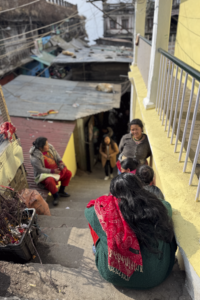
Darjeeling’s G-building, once a colonial residential quarter, now opens onto Chowk Bazaar, a bustling market for local products. What immediately stands out is how visibly segregated the market is. Certain lanes sell certain products, and these products are almost always sold by vendors with specific identities.
The lane right at the steps of the Z-Building drew our attention in particular. There was something contradictory about it: it felt stable, almost timeless, yet the constant flow of people moving through it created a sense of urgency. Standing still felt unnatural. Abhimanyu’s team found it surprisingly difficult to pause, to ask questions, to linger. The market demanded movement.
Beyond the market as a foodscape or a place of commodity exchange, what stayed with us most were the social interactions unfolding within it. As we walked through the bazaar with a video camera, a toddler, fascinated by the equipment (or our ‘foreign’ presence) began following us. Barely able to speak, he soon became the centre of attention, not just for us, but for the entire market. He persistently trailed behind us, and when we decided to approach his mother, we realised the woman who was watching over him was not, in fact, his mother. Nor was anyone else in particular. The child, in a way, belonged to the market itself. Vendors, passers-by, and shopkeepers all kept an eye on him, tracking his movements and ensuring his safety. It struck us then that in Darjeeling, it sometimes takes an entire market to raise a child. Kinship here felt collective.
Waste was another sensation that emerged strongly. Amidst the hullabulla of the market, its colours, smells and sounds, Suren, a participant from Sikkim, pointed out its filthy appearance. This sparked a discussion within the group about aesthetics. What if the market were spotless, speck-free and orderly? Would it evoke the same atmosphere, the same intensity, the same movement?
Dirt is often simply matter out of place. We found a discarded lottery ticket on the street. Had it “got through,” had it won, it would not have been a waste at all, but a prized possession, carefully preserved. Its status as dirt was contingent, fragile, and situational.
Belonging Forest
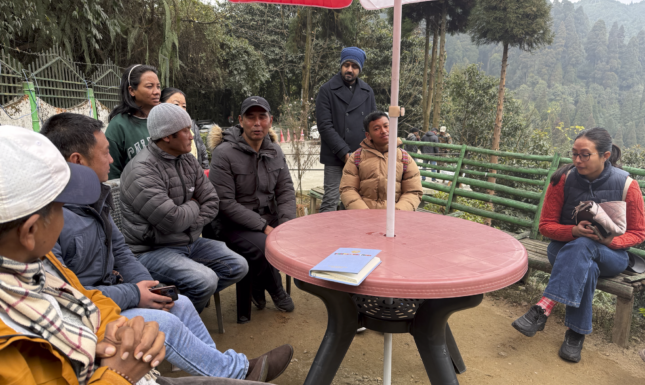
Anna’s group visited the Lloyd Botanical Garden’s satellite forest. Local residents used to collect firewood and medicinal plants freely, calling it a community forest. Yet redesignated as a biodiversity conservation park, the same forest, now gated, protected and monitored by the Forest Department (FD), deals with an uneasy sense of community absence.
We were welcomed by FD officers and several residents. Conversation immediately unfolded in Nepali. Our Nepali-speaking members, some of whom were also ‘local’, acted as intermediaries, facilitating dialogue between residents and officers for over an hour. For the rest of us, partial or no comprehension produced a palpable sense of disconnect, revealing how access to place is shaped not only fences and policy but also by language.
Certain sounds and species anchored the site in a recognisable Darjeeling landscape. The toy train’s whistle echoed across the mountains, amplified through a directional microphone. Stands of grand Darjeeling pine trees—emblematic of colonial settlement—marked the slopes. Yet these trees are native to Japan (japonica) and are now rendered invasive within this biodiversity conservation space.
Human arrivals, whether colonial settlers, tourists or nearby residents, have repeatedly reorganised this forest, shaping and being shaped by the movements of other beings simultaneously: introducing plants, free-ranging dogs, and increasingly, leopards. As anticipated and speculative futures for and of the forest expand, restriction and freedom are constantly renegotiated.
What emerged was a more-than-human politics of belonging. With infrastructural development and desired visitors, processes of futuring the forest reconfigure who, or what, may belong, and for whose future that belonging is secured. The forest itself seems to be sensing its own belongingness.
Agential Spatiality
When we first pitched the idea of Sensing Darjeeling, some academic participants dismissed it as ‘qualitative research 1.0.’ Yet after just a day of ethnographic exploration alongside regional experts beyond academia, it became clear that the process itself extended the very mapping we set out to undertake. Group discussions, at times heated, became central to how Darjeeling was interpreted. These exchanges, culminating in a collective presentation, foregrounded the limits of any single positionality: local, foreign, non-resident, academic, and highlighted sensing as necessarily partial and relational.
We were not simply ‘sensing’ Darjeeling as an object of inquiry. Its spatiality actively directed our movements, encounters, and modes of attention. Established narratives of the town and their entanglement with contemporary everyday life both enabled and constrained how and what could be sensed. Spatiality itself emerged as agential, directing the terms of engagement while remaining unevenly accessible.
We found that sensing, knowing, and belonging are preconditioned yet contingent and subject to contestation. The act of futuring may unfold through these incommensurabilities.





0 Comments
Add a comment