
From buckwheat to white rice: transforming food systems and multispecies relations in rural Bhutan

Elena Neri, a visiting PhD fellow at Leiden University, explains her research on transforming food systems, multispecies relations, and more-than-human health in a community of rural villages in western Bhutan, where she carried out fieldwork between March 2024 and March 2025.
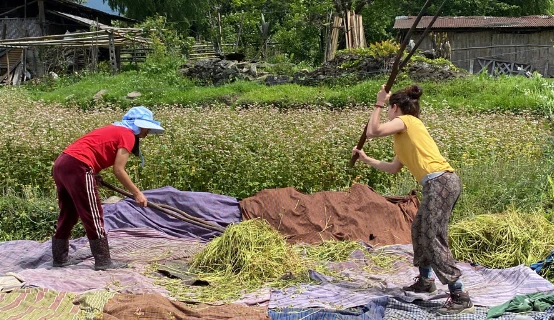
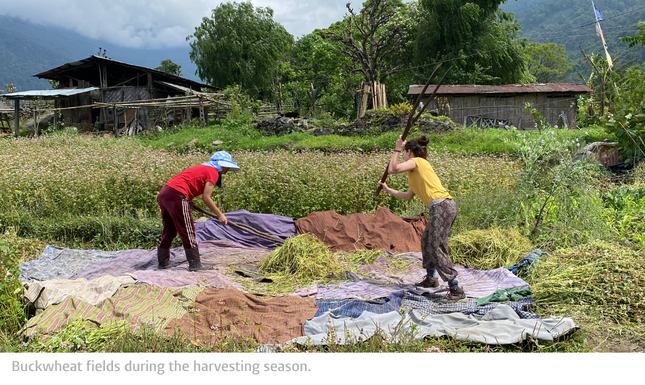
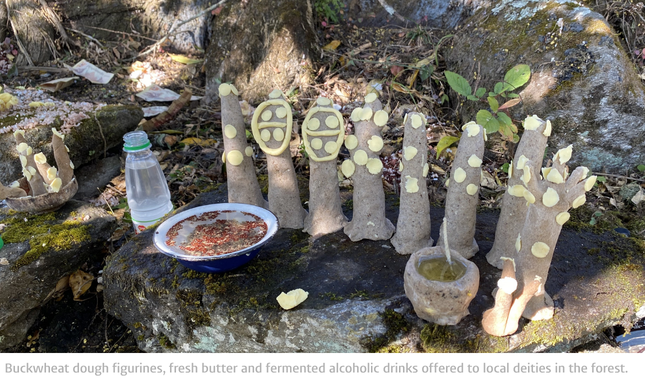
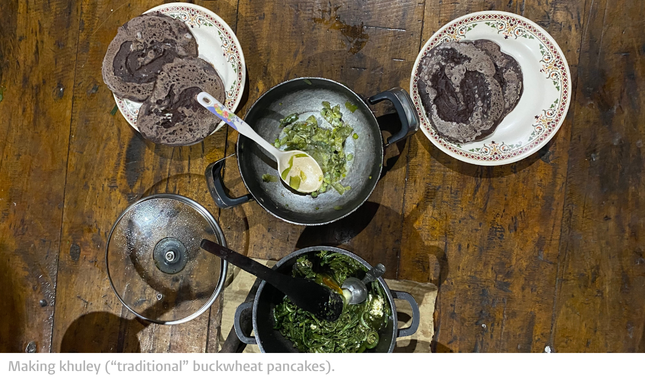
We sat by the bukhari — the “traditional” Bhutanese stove — while Ama, my host mother, poured liquid buckwheat batter onto the hot surface to make khuley, buckwheat pancakes. A few days earlier, together with other village women, we had manually ground the seeds after months of carefully tending the plants. After the harvest, the best grains were set aside as offerings to appease the Lu, serpent spirits of the soil. Some of the flour was shaped into buckwheat figurines for other deities and forest spirits, offered in the hope of securing future successful harvests. The leftover stalks were fed to Ama’s two cows, which in turn provided fertile manure for the fields.
When the khuley were ready, Chandra — the research assistant with whom I shared my fieldwork — and I savoured the thick pancakes, feeling their rough texture and slightly bitter aftertaste in our mouths, throats, and stomachs, and enjoying the resulting sense of satiety and comfort. Ama told us she was glad we enjoyed khuley, since her children, now in the capital and in Australia, preferred cheap white rice imported from India. Elder villagers say this is why the young have become weak and unable to work in the fields: they are made of different matter. New Jersey cows introduced by the government, too, no longer eat local plants and ancient grains like indigenous cattle. Instead, they depend on industrial feed. Even local deities now receive fewer buckwheat offerings, as “traditional” foods are replaced by packaged products and people travel by road rather than spending ritual nights in the forest.
Ama sighed as she flipped another pancake. “Food has always been enough for me. But now everyone wants to go to the cities, to Australia. They cultivate cardamom instead of buckwheat. They want money, not food.”
Rural Bhutan and local food systems in times of radical transformation
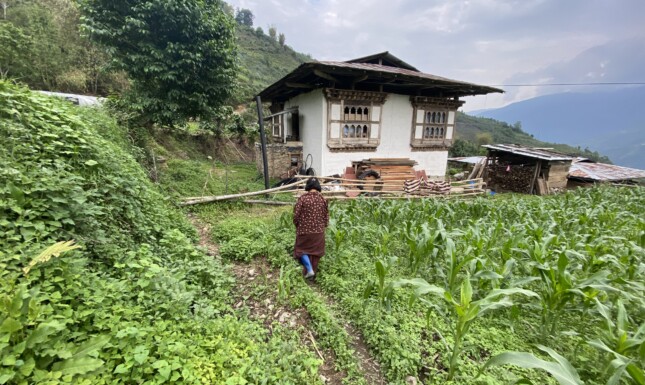
I carried out my ethnographic fieldwork in a community of rural villages in the Haa district of western Bhutan. “Everything has changed here: the difference is like that of sky and earth,” villagers often told me. The area had recently gained its first road (built in 2018), access to electricity, and a hydropower dam — all part of Bhutan’s wider development plans. These changes enabled access to markets, the spread of imported foods (particularly white rice and ultra-processed snacks), and significant dietary shifts that correlate with rising chronic diseases such as diabetes. This reflects a broader transition from subsistence agriculture to a cash-based economy. Traditional staples like buckwheat, indigenous cattle, and organic manure are increasingly replaced by cash crops, more “productive” crossbred cattle, and industrial inputs. These shifts are intensified by climate change and by recently enforced Buddhist guidelines restricting killing and hunting. Similar transformations occur across the Himalayas, where modernisation and rural depopulation intertwine — themes also addressed in the projects Perpetuating Bhutan Highland Heritages and Futuring Heritage (you can read more about the latter in blog posts by Erik de Maaker, Anna Notsu and Abhimanyu Chettri).
As Ama and other villagers expressed, these changes alter relations not only among humans (elders and youth) but also between humans and other beings — relations that were once grounded in mutuality and care. Villagers are therefore reconfiguring their food systems, diets, and relationships with plants, animals, and “sentient” landscapes (inhabited by numinous entities), as they search for new forms of socio-ecological balance. Some food-related rhythms and life cycles are disrupted, while others persist and emerge, blending communal ethics of care with the logics of global capitalism, and local vernacular knowledge with technoscientific approaches. Local food systems emerge thus as sites of loss, adaptation, and contested futures — places where we can examine and understand transforming multispecies relationships, landscapes and political ecologies.
Consubstantiation, cycles and more-than-human relationships
Beyond being central to daily activities, food mediates relationships among humans, plants, animals, microbes, deities, and other beings. My research explores shifting human, other-than-human, and more-than-human entanglements to understand how these transformations affect food systems, multispecies life, and more-than-human health — and how relationships are disrupted, maintained, or reconfigured. This is relevant not only in Bhutan but across the Himalayas and beyond, where rural livelihoods and multispecies life cycles are being reshaped by development and other forces. In line with the EATWELL project of which my research is part, my work seeks to approach food systems in their complexity, multidimensionality and holism.
Situated at the intersection of food anthropology and multispecies studies, and inspired by feminist posthumanism and the environmental humanities, this research foregrounds care, cycles, and mutual relationships through the lens of food. A key concept in my research is Carsten’s notion of consubstantiality — the idea that eating the same food and being made of the same substance brings bodies closer, both materially and symbolically. While Carsten focuses on human bonds, I extend this to relations between humans, nonhumans, and landscapes, as well as to what happens when such ties are disrupted.
This framework allows me to examine food in its social, relational, cosmological, bodily, affective, health-related, and microbial dimensions. Consubstantiality captures, for example, the sense of fragmentation that Ama felt toward her children, her cows, her local deities, and her landscape — all increasingly less made of buckwheat. This staple once created bonds through symbolism, nutrition, gut health, memory, affection, and mutual care. Replacing it with imported white rice reshapes these cycles, rhythms, and relationships in profound ways. This is just one example of the shifts I explore in my thesis, and which I hope to discuss and further develop during my visiting time at Leiden University.
About the EATWELL project
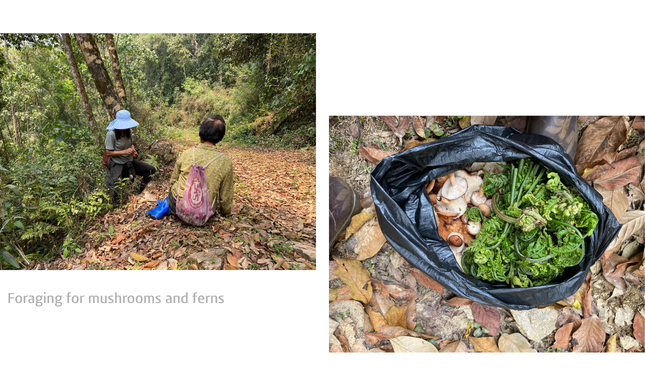
EATWELL is a radically interdisciplinary project led by associate professor Wim Van Daele, funded by the Norwegian Research Council, and carried out with partner institutions in Bhutan, Norway and Belgium. It examines food systems and more-than-human health across different sites in Bhutan. Bringing together anthropologists, nutritionists, and microbiologists, the project investigates how socio-ecological environments enter human guts through farming, herding, foraging, processing, buying, cooking and eating. Through three interconnected phases — an ethnography of food systems and practices, a nutritional survey, and faecal sampling followed by microbiological analysis — EATWELL seeks to understand how the socio-cultural-ecological relates to the biological, and how human health is inseparable from the health of the environment and the beings that populate it.






0 Comments
Add a comment