Looking back on the second Leiden Anthropology Conference


When CADS convened the first Leiden Anthropology Conference in 2020, the Institute of Cultural Anthropology and Development Sociology – home to 57 people – aimed to create a community for the one hundred anthropologists or so working in the Leiden and The Hague faculties, museums, research institutes, and PhD programs.
In September 2024, with the pandemic behind us but still facing budget cuts and a national and international context that increasingly discourages diversity, dialogue, and cultural understanding, we (the panel convenors) began to consider a second Leiden Anthropology Conference as a moment of visibility, solidarity, and hope for the community we established back then, which has in the meantime grown and developed. On October 10th 2025, CADS affiliates 112 people, of which 53 employed as scientific staff.
Reflecting on our legacy and exploring our prospects
We offered this day to focus on the expertise and vision of our community in and around Leiden. This includes not only anyone working and studying at, or collaborating with, CADS, but also the broader community of anthropologists working across the city’s different faculties, institutes, and museums. We came together to share what we are and what we know, exploring our critical engagements with future and past; our agency and legacy of almost 150 years of anthropology at Leiden; our prospects and reflections; and celebrate connections and potential.
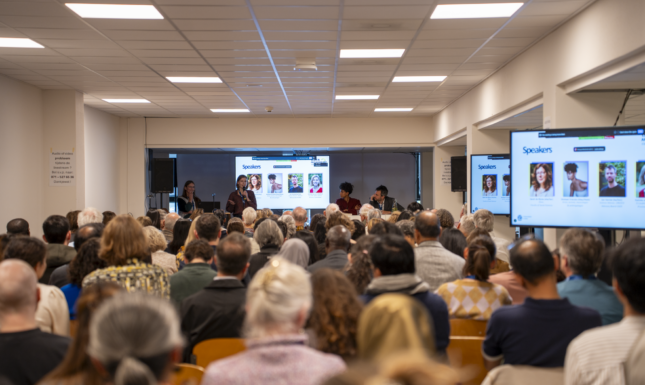
In the opening and closing plenaries, with graduates, advisors, and students, we reflected specifically on what anthropology has to offer to professional, social, and scholarly (self)development. Plenary speakers were CADS advisory board member Jon Verriet and former students Shishani Vranckx and Katinka Janssen. We asked them: How did studying anthropology help you (or not)?, Looking back, what do you miss?, Are there any questions or issues that you think we should address for the sake of the Leiden Anthropology community?
>> See how our plenary speakers answer some of these questions.
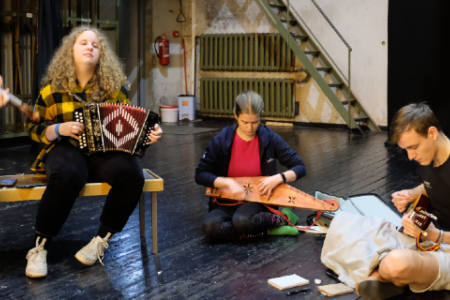
More than 150 people registered to attend. The key points of the plenary speakers’ interventions focused on the richness and variety of skills and abilities of our anthropological community. For example, Shishani’s talk outlined how their anthropological work with folk musicians in Namibia is not ethnomusicology alone. It also brings in the social and political context, bridging musical knowledge and anthropological understandings of power dynamics. Katinka underlined the listening skills of ethnographers, crucial also when working in politics and for public institutions. Jon recommended that we look at institutional processes holistically – something we learn as cultural anthropologists but also applies to policy advice, science communication, and world heritage.
Diversifying Heritage
Among the panels (please see the full list and panel descriptions with speakers here: Leiden Anthropology Conference 2 - Leiden University), the well-attended double session ‘Diversifying Heritage’ explored how processes of making, evaluating, and even rejecting heritage shape how we assess the past in light of our expectations for the future. Sixteen presenters delivered short, five-minute pitches in an interactive stand-up format. The speakers included scholars from the Leiden Faculties of Social Sciences, Humanities, and Law, as well as representatives from the Amsterdam University of Applied Sciences and the Dutch Centre for Intangible Cultural Heritage. In their presentations, they demonstrated how heritage-focused discourses influence the formation of social groups and can help address major societal challenges. Several pitches examined how heritage-related discourse can create conceptual spaces where stakeholders with conflicting interests, worldviews, and ontological perspectives find common ground, for negotiation or for dissent.
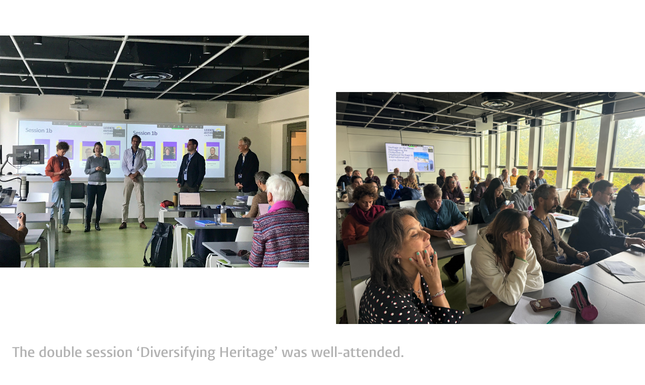
The dynamic format and wide range of contributions sparked lively discussions. Participants raised critical questions, such as: If labeling something as heritage transforms past social practices in the present, who benefits from these changes? And are those who benefit necessarily the ones who should? The double panel, in the large number of attendees it attracted, and the lively discussions it triggered, made clear that heritage is a theme prominently figuring in the research of many Leiden Anthropologists.
Legacy of the Louwes Fund
In the panel ‘Legacy of the Louwes Fund’, an overview was presented of all the research done by recipients of a fellowship of the Louwes Fund for Research on Water and Food. This fund was created in memory of a former alumnus of Leiden University, Hendrik-Jan Louwes. The coordinators, Gerard Persoon and Hans de Iongh, gave an overview of how this fund was spent on themes related to water management, food procurement and consumption and human-wildlife conflicts in various countries. Presentations were given by students from Cameroon, Kenya, Indonesia, the Philippines, India, Nepal, and Kenya who successfully defended their PhD work at Leiden Universities in the past years. They reflected on the impact of their previous research on their present activities. The Louwes Fund has also been instrumental in setting up an international course on water management in the Cagayan Valley in the Philippines, which was organized for more than 10 years. A newly made documentary about this course and the future challenges in water management in the area was shown.
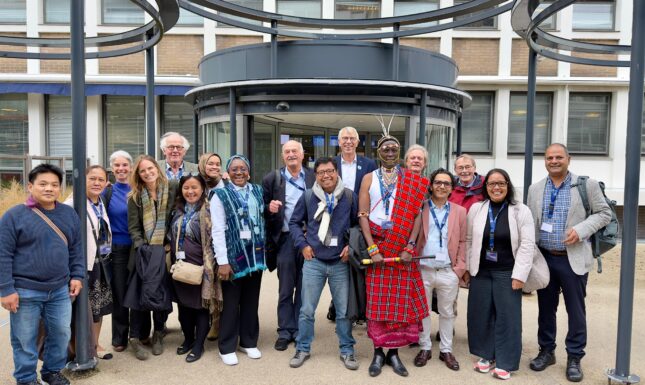
The other parallel sessions, with diverse formats ranging from pitches to round tables and hands-on workshops, were devoted to discussions on South-South-North exchanges and emerging perspectives from (South-East) Asia and (West-) Africa; the politics of knowledge and how it relates to (environmental) change; everyday infrastructures and the ‘anthropology of the day after’; and the role of collaborators in the field.
The plenary discussion, with rapporteurs from each panel, included a critical reflection on the role of ‘hope’ as well as on the use of ‘jargon’ in academic language. The well-attended borrel, rich follow-up conversations, and generous testimonies given by the plenary speakers confirm the salience of anthropological skills and contributions for society at large.
Acknowledgements
Cristina Grasseni (conference convener) and Sarah Bozuwa (conference organizer)
Louise van Gent, Marit Pauwels and Mariska Moreu (logistics)
Ilias Marios Chaliamalias and Megan Rodrigues (film and photography)
See the full list of contributors on the programme page.



0 Comments
Add a comment