

Johannes Fabian (19 May 1937 - 6 January 2026): A Personal Appreciation
In January of this year, Johannes Fabian passed away at the age of 88. He will always be remembered, far beyond disciplinary boundaries, for his Time and the Other.

Time and the Other was the first and – eventually – most influential book in anthropology’s “literary turn” (even if Writing Culture staked a rival claim to prominence). But Johannes’ complaint that Time was massively cited but meagerly quoted resonated personally: like many, I never read the book cover-to-cover. This, however, was less caused by the – indeed daunting – theoretical rigor of his writing than by the vigor by which he presented, around the time the book was published, its core arguments to students at the University of Amsterdam. Johannes made his theorizing unforgettably accessible by word of mouth, as he highlighted historical events – whether the demise of Bossuet’s Christian time, or the success of Petrus Ramus’ taxonomic diagrams – or showed how the “ethnographic present” insidiously denied “the other” a place in the writer’s present. After that, selective forays into the book sufficed whenever I needed – to use his own words – the rigor of his writing to enhance the vigor of his plea to rethink social science and history.
Language, history, and materiality sum up the many “turns” Johannes cultivated in this rethinking: they humanized his social science, but also turned him into an outstanding teacher. One memory stands out: Johannes brought a small carton soapbox from South Africa to the UvA Currents in Anthropology seminar that he initiated. He meticulously attended to the images and texts on each of its six sides, not passing on to the next until every material detail had been noted, demonstrating how the racist politics of Apartheid were folded into this seemingly innocent artefact. In Johannes’ hands, material culture could become a revelation, promising students that they were able to think big issues by paying close attention to tangible details. He repeatedly stressed that anthropology was the most philosophical of the social sciences, not just by theorizing about, but by caring for what ordinary people – including us researchers – think and do. He insisted – from his Catholic background, but more importantly from his reading of the young Karl Marx – that thinking and material production were inextricably linked. He told us to treat speech as bodies moving to produce sound waves; that text, for most of its history, was something people placed on paper by inky substances. Those who ignored how cultural intangibles require tangible production failed, in Johannes’ eyes, to understand how and when language historically constructs our material interactions.
Teaching students the basics of ethnography, I often prescribed Johannes’ early and visionary essay on “Language, History and Anthropology” (reprinted in Time and the Work of Anthropology: Critical Essays 1971-1981). It records Johannes’ experience of learning both the speaking of Shaba Swahili and the identification of members of the Jamaa religious movement in Congo at the same time, as he subjected himself to their language and history in the process of communicating about their way of life. However, this simple message was wrapped in multi-syllable abstractions, meant to convince philosophers of science that they should discard positivist ideas about “mastering” theory and “controlling” research by “methods and techniques”. One of these abstractions is the young Marx’s notion of “totality”, which Johannes used in this essay to refer to a social and historical entity that encompassed the material interaction between researcher and researched – something that would always elude the conscious grasp of both. This reality, therefore, was not a “case” of pre-formed theoretical insights but a “product” of the way these persons subject themselves to each other, as they “inter-subjectively” make and suffer their mutual objectification in material practice (see Time and the Work of Anthropology: Critical Essays 1971-1981, page 10 in particular).
This insight was beautifully realized recently by a student of the Reinwardt Academy for heritage professionals after I asked her to read Johannes’ essay for her training in ethnography: while her apprehension of such “academic texts” made her want to avoid them earlier, she experienced their challenge as less daunting after reading the text: even if some abstractions remained hard to grasp, they made her relate to the “passions and interests” of a practical researcher. Indeed, Johannes himself showed his awareness of such joint immersion in a totality-always-out-of-reach in a drawing.
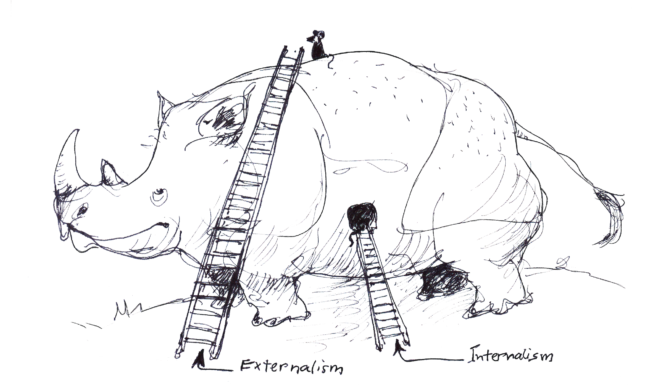
It gently mocks the participants in the debate whether science was either constituted by its internal methods and procedures or by external socio-cultural factors by portraying both sides as mice who study a rhinoceros but are incapable of observing the total animal, whether from the top down or from the inside. This “immodest modesty” – of knowing, on the one hand, that “the whole rhino” exists, yet, on the other, that one cannot know it fully – is, I feel, the key to Johannes’ rethinking of anthropology as well as to understanding his disinterest in establishing a “school” of thought.
The anthropologist Fabian made big claims: Time and the Other testifies to the vast scope and energy by which he put an entire discipline on trial. And yet I never felt he forced me into a paradigm or methodological straightjacket. He was a scientific master who taught the dangers of assuming scientific mastery. “Visualist” rhetoric of “distanced observation”, to him, obscured the social dependence of ethnographers on their interlocutors’ insights and engagement. He feared critiques that reified global power relationships – such as dependencia theory, popular in Amsterdam at the time – because they inhibited recognition of centuries of (anti-) colonial agency. He worried that ethics in anthropology might privilege top-down “moral indictment” over self-reflexive awareness of “intellectual failure” in realizing social conditions of producing knowledge (see “Forgetting Africa”, page 14 in particular). There are, therefore, multiple ways in which scientific mastery can degrade from, at best, an honest ideal, to, at worst, an addiction to control. Remaining conscious of not knowing “the total rhino” warns you against that.
Johannes’ modesty in admitting to only partial truths about ”totalities”, therefore, also appeared in what I experienced as a training in “moments of freedom”. The term “moments” highlights that Johannes both recognized and made time, for coevalness in research relations as much as for sharing a beer or a dinner with colleagues and students. “Freedom” expresses that good social scientists do not need paradigms and schools so much as a research practice that liberates both researchers and interlocutors from oppressive structures. If Johannes left a legacy, it was by showing why collaboration should be anthropology’s epistemic standard.
0 Comments
Add a comment